Friday, 10 May 2013

Who killed King Harold at the Battle of Hastings?

This scene from the Carmen is the one that most interests popular historians.  The death of King Harold is described from line 533 to line 554.


535.           Advocat Eustachium liquens ibi praelia Francis,
The duke summons Eustace from the Franks then clearing the field,

536.           Oppressis validum contulit auxilium.
He musters strong aid for the oppressed.

537.           Alter ut Hectorides Pontivi nobilis heres,
Like a second Hector, the noble heir of Ponthieu,

538.           Hos comitatur Hugo promptus in officio.
Hugh accompanies these, ever ready for duty.

539.           Quartus Gilfardus patris a cognomine dictus.
Fourth is Gilfard, called by his father’s surname.

540.           Regis ad exicium quatuor arma ferunt.
The four come armed to overwhelm the king.


Each of the four plays a role in the death, so that King Harold falls to lance, sword, pike and axe. 

The death of Harold was already in dispute in 1067, as the Carmen's composer notes at line 542, so he would have been cautious in writing a record of the battle that he then hoped would be read throughout the world.

It seems likely quite a mob of allied cavalry responded to the duke's summons for an assault on the summit.  The resulting melee may have been variously reported.

Guy d'Amiens may have been anticipating other claims for the credit of killing King Harold. The story of an arrow striking down the king first emerges from Amatus of Monte Cassino in 1080.  The Italian archers at the Battle of Hastings may have wanted credit for the famous victory. 

Certainly the archers and crossbowmen were critical in overwhelming the superior numbers of Saxons in the shield wall and fyrd.  Their pikes, swords and axes, and even their spears, would have been ineffectual against allied artillery firing at them all through the morning, as described in the Carmen, decimating their ranks from a safe distance.  The terror of death raining down on them while they stood helpless must have been maddening.  Saxons had never confronted crossbow bolts before, capable of piercing their shields and chainmail.  Even the Norman arrows were steel tipped and barbed for maximum penetration and damage, and they had spent all year manufacturing sufficient arms for the attack.  Having provided the strategic advantage which assured victory for the Normans, the allied archers from Italy may have sought credit for the death of King Harold as well.

The Bayeux Tapestry does not clarify things much here.  There are two figures potentially identified as Harold in the scene titled "Here King Harold is killed".
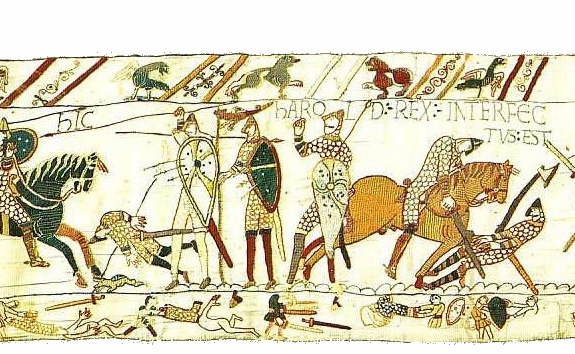
One might have an arrow in his eye, although it is suggested this was added later.  The other is being cut down by a knight, and possibly having his leg cut off.  The Carmen would support the later image as being King Harold.  The Carmen depicts Harold as fighting bravely to the last.

Interesting to note the French already stripping the dead of anything of value in the lower margin of the Tapestry, again consistent with the narrative of the Carmen.


Saturday, 4 May 2013

A medieval data standard? The Carmen suggests a Barony Naming Convention

A lot of the globalisation of financial markets has been driven by the implementation of global data standards so that computers can talk to each other in the same language around the world.  I've been involved in developing these data standards for international payments and securities markets for almost 20 years.  As a result, I am perhaps more sensitive to data standards than many.

Perhaps that is why I am drawn to Latin.  Latin was a global Roman-era and medieval data standard for globally consistent communications.  Anyone speaking or writing Latin could communicate with anyone else speaking or writing Latin throughout the Roman Empire or the Catholic Church.

When I first read through the Carmen in Latin portus ab antiquis Vimaci - the ancient port of Vimeu - at line 48 leapt out at me, as I had already read somewhere that the Norman invasion fleet departed from St Valery-sur-Somme, at the mouth of the Somme River.  Indeed, the description of the port in the Carmen said that the Abbey of Saint Valery overlooked the port and that it was at the mouth of the Somme, so there could be no mistake.

So what or where was Vimaci?  Why was the name Vimaci used by the Guy d'Amiens writing the Carmen instead of the name of the port, despite his being otherwise very economical in his text?

Vimeu is not a port or even a town.  It was a medieval barony.  The medieval barony spread inland from the coast of the Somme covering a pretty large area.   As soon as I saw this, I thought <barony naming convention/>!

The cleric who wrote the Carmen adopted a convention of ignoring local place names in favour of referencing the barony associated with the local place and supplementing the barony name with locally descriptive features.  If this was true for Guy d'Amiens, it might be true for other medieval clerics as well.

A barony naming convention would explain why the Normans called it the Battle of Hastings instead of naming it for the battlefield.  The battle took place in the Rape (barony) of Hastings on land that was subject to Hastings' jurisdiction.  The Saxons called it the Battle of Senlac according to Orderic Vitalis, after the local name of the place.  Senlac means "sandy loch" and would fit the wide, sandy Brede Valley flood plain through which the estuarine Brede River meandered.

A barony naming convention would explain why the makers of the Bayeux Tapestry wrote that the fleet sailed for Pevensey if it landed in the valley.  The ports of Brede and Petit Iham were limbs of Pevensey, owing the service of ships, men and boys to the League of Pevensey each year for fixed terms.

38 HIC WILLELM[US] DUX IN MAGNO NAVIGIO MARE TRANSIVIT ET VENIT AD PEVENESAE Here Duke William in a great fleet crossed the sea and came to Pevensey

File:BayeuxTapestryScene38.jpg

A barony naming convention would explain why the raiding parties went to loot Hastings though it is clear from the pictures in the tapestry - and particularly the depiction of the boats with open oar ports - that the camp was some remote distance from Hastings along the coast.

40 ET HIC MILITES FESTINAVERUNT HESTINGA UT CIBUM RAPERENTUR and here the knights have hurried to Hastings to seize food

File:BayeuxTapestryScene40.jpg

A barony naming convention would explain why the makers of the Bayeux Tapestry wrote that the a motte was erected at the Hastings camp.  Iham Hill was a parish in the jurisdiction of medieval Hastingas, probably going back to the original 790 King Offa charter giving Hastings, Pevensey, Londonwick and other ports and trade privileges to the Abbey of Saint-Denis.  The camp of the invasion force was in the Rape of Hastings.

45 ISTE JUSSIT UT FODERETUR CASTELLUM AT HESTENGA CEASTRA He ordered that a motte should be dug at Hastings Camp


File:BayeuxTapestryScene45.jpg
The same barony naming convention would explain why the army marched from Hastings to go to battle.  If the building shown is the rebuilt "fortress lately razed" of St Leonard's Church on Iham Hill, then it makes sense.  St Leonard's was a parish of Hastings, in the Rape of Hastings.

48 HIC MILITES EXIERUNT DE HESTENGA ET VENERUNT AD PR[O]ELIUM CONTRA HAROLDUM REGE[M] Here the knights have left Hastings and have come to the battle against King Harold

File:BayeuxTapestryScene48.jpg

Hastinga being sacked is clearly different to Hastinga Ceastra where they have camped, and both look different to the fortified place from which the army marches.  If they are all named Hastings because of a Barony Naming Convention, then these diverse scenes of the Bayeux Tapestry which seem to imply three different places may finally make sense.

I am not enough of a medieval scholar to know whether others have detected the use of a barony naming convention before in other medieval clerical works, but I am very keen to find out!

Sunday, 28 April 2013

What's wrong with the Barlow Carmen?

The short answer to the title question is I don't know what's wrong with the Barlow Carmen.  I haven't seen the Barlow Carmen.  It costs over £100 on Amazon and isn't available from any public lending library in southeast England.  I might have been able to obtain it on inter-library loan from the British Library, but I am not a scholar and didn't want it for research.  I wanted a Carmen to read for personal enjoyment.  I wanted a Carmen to understand the contemporaneous Norman story of the events of the conquest as they unfolded in 1066.

Now that I have produced my own English translation of the Carmen, those familiar with the Barlow Carmen ask why I bothered. The question has been raised five times in three months, so here is the answer: temporary insanity.

I never intended to translate the Carmen before actually doing so.  I took possession of the only English translation Carmen I could obtain (the 1972 Morton & Muntz Carmen) from my local library on 25th January, having waited three weeks for the single copy available in southeast England.  Within days the Carmen took possession of me.

It is an indictment of the academic press that the Carmen is so hard to get and so expensive.  Every schoolchild in Britain should know about the Carmen as a thrilling story of blood, plunder and conquest that shaped world history.  Every English historian should have a copy as a fundamental reference work for the Norman Conquest.  Although if they were exposed to the M&M version, they might not find the story either gripping or credible.  Right away I began to see problems with the translation.

I started translating a few lines myself, one or two at a time, and the more I did, the more obsessive I became.  There is so much more in the Carmen than appeared in the English.  I stopped reading the English.

I found the original transcription of the Carmen published in Rouen in 1840 and another transcription from 1869.  I transcribed the Carmen in Latin from beginning to end on my computer, and then began translating it from line 1 to line 835.  When I finished I went back and re-translated for sense and context.  The Latin is so elegant that if the English jarred or seemed disruptive then I knew that I had missed something.  Where the Latin didn't make sense, I checked all the transcriptions for possible errors and made sensible corrections of my own.  I kept doing this obsessively for three months, sometimes 20 hours a day.  My son became frightened when he started coming home from school to find me still hunched over the keyboard in my jammies, not having bothered to eat, brush my teeth or feed the cats.  If anyone doubts the originality of my efforts, I have plenty of translations of incrementally improving quality to prove that I did the work.

Why is my Carmen worth reading?  First, it's a cracking good story of blood, plunder and conquest - as its author intended it to be.  Second, it costs £100 less than the Barlow Carmen.  If you want a Carmen that reads well and doesn't put you in debt, mine is a sensible choice.  Third, my Carmen is available worldwide instantly as an ebook, where the Barlow Carmen is almost entirely unavailable to the public except to scholars with access to specialist libraries or people who can drop £100 on a book.  Finally, and perhaps most important, my Carmen is free of received translation and therefore probably truer to the original Latin.  I'll let others compare the texts, but I know for certain that I reveal significant new facts about the Norman Conquest while still translating the Carmen word for word from the original.

It is important that the history the Carmen reveals about the Norman Conquest be better understood and more widely available.  

What's wrong with the Barlow Carmen?  It isn't publicly available.

Thursday, 28 March 2013

Blogging the Carmen and the Conquest

Today's the big day.  I'm getting ready to hit the publish button to send my translation of the Carmen off to Kindle for publication.  So I guess this first post to the blog is about why I did it.

There is only one contemporaneous account of the Norman Conquest: Carmen de Normannicum Conquestum or The Song of the Norman Conquest.  The Carmen is an 835 line untitled epic poem attributed to Guy de Amiens, Bishop of Amiens, probably penned in early to mid-1067.  He drew on eyewitness accounts of the events depicted, and dedicated the resulting poem to Lanfranc of Pavia, Abbot at the Abbey of St Stephen at Caen in 1066 and Archbishop of Canterbury from 1070.  Lanfranc was a close advisor to William the Conqueror on religious and political matters and his intermediary in dealings with the pope.  He was in a position to have observed first hand all the events described, and indeed, may have been one of the sources for Guy de Amiens in compiling the conquest story.  Lanfranc is invited by Guy in the dedication of the Carmen to amend his draft to make it acceptable for publication to the world.  For these reasons, the Carmen is broadly regarded as providing the most authoritative account of the Norman Conquest.

The Carmen only exists now as one Latin manuscript in Medieval Latin miniscule script on vellum, with a further fragment of the first 66 lines, in the Royal Library of Brussels.  It is a very fragile record of the great events of 1066.  Years later the Bayeux Tapestry would depict the same scenes, but that is the graphic novel version of the conquest story.  It is the Carmen alone that offers the official record.  Every word has weight, every line has import. 

The image below approximates the actual size of the Carmen manuscript:


I started my own English translation frustrated by the quality of the 1972 translation published by Oxford Medieval Texts.  The translators missed a lot of context, and good translation requires context.  I am sympathetic that theirs was a fair effort, but modern techniques make a better translation possible and perhaps inevitable.  And I rejected utterly their tortured punctuation in favour of a much simpler model.  It seemed to me that the author had carefully scripted and delimited his ideas line by line.  Once I grasped the tight and elegant structure of the Carmen, if my English jarred, I knew it was wrong.

I began working through a few lines at a time just for fun, to discover for myself the meaning in key scenes of the Carmen.  Soon it was an obsession to unlock all the meaning and make it accessible in English to a wider readership and wider scholarship.  I hope the result is a cracking good read that will be enjoyed by everyone who comes to it, whether Latin scholar, armchair historian, battle re-enactor or student.

When it originally appeared in a French collection of Anglo-Norman Chronicles it was styled Carmen de Hastingae Proelio - the Song of the Battle of Hastings.  A further transcription a decade later title it Carmen de Bello Normannico - Song of the Norman War.  I do not regard either of these earlier names as accurately capturing the scope of the Carmen. The Carmen provides an account of the Norman Conquest from departing Dives to St Valery-sur-Somme to the a camp and fortress on the Sussex coast to the bloody battlefield to Hastings to Dover to Winchester to London to Westminster.  It encompasses everything from the preparation of the fleet to the coronation of William the Conqueror.  It offers history, religion, blood, plunder, politics and conquest.  For these reasons I am giving my translation of the Carmen the bigger and more accurate title:  Carmen de Normannicum Conquestum - The Song of the Norman Conquest.

As I began to put history to the narrative of the Carmen, many surprising facts came to light, and many surprising patterns emerged.  Some of these facts will be at odds with the received wisdom and general understanding of English history about the conquest.  That is unfortunate, but progress requires the recognition of error.  The Carmen is very likely right, and history as it is taught is very likely wrong.  So much of what we think we know is what we choose to know.  Perhaps it is time to offer a wider choice that places English history in a wider context, painted on a wider canvas.  

My translation of the Carmen makes the following revelations:
  • Where the Norman fleet landed on the Sussex coast;
  • Where the camp was erected;
  • Where the former fortification was restored and why it had been razed;
  • Why certain parts of Sussex and Kent were raided and not others;
  • Where the battle might have been fought;
  • Where the thousands of Saxon and Norman dead are likely buried;
  • Where Harold died and where Harold's remains were likely buried;
  • The identity of the Norman prelate at the bilingual coronation in Westminster Abbey;
  • Why Battle Abbey couldn't be on the battlefield and why the alternative site was chosen.
These are big advances in the conquest history.  They require a lot of confirmatory authority and archeology.  That requires a team rather than an individual effort, and years rather than weeks.

The objective of this blog is to provide a forum for sharing ideas and evaluating theories that emerge as the Carmen reveals its own truth about the events of 1066.  In like spirit to Guy de Amiens, I am happy to learn from others and to open my work to collaboration and supplement.