Monday, 16 February 2015

Understanding Bede: Correcting 2 Common Errors and a Jest in Paragraph 1, Chapter 1

The thing I love about Latin is the precision and richness of the language, which is why I find bad translation so irritating.  Word order is not so important because case and tense and other indicators of grammar confirm the intended meaning clearly.  Yet bad translations are often the received stuff of English history because too many English historians, like historians everywhere if we're honest, prefer inaccurate, romantic, patriotic whimsy to accurate but uncomfortable historical truths.

Below is the Venerable Bede's first paragraph of his Ecclesiastical History of the English People.
Brittania Oceani insula, cui quondam Albion nomen fuit, inter septentrionem et occidentem locata est, Germaniae, Galliae, Hispaniae, maximis Europae partibus, multo interuallo aduersa. Quae per miliapassuum DCCC in Boream longa, latitudinis habet milia CC, exceptis dumtaxat prolixioribus diuersorum promontoriorum tractibus, quibus efficitur, ut circuitus eius quadragies octies LXXV milia conpleat. Habet a meridie Galliam Belgicam, cuius proximum litus transmeantibus aperit ciuitas, quae dicitur Rutubi portus, a gente Anglorum nunc corrupte Reptacaestir uocata, interposito mari a Gessoriaco Morynorum gentis litore proximo, traiectu milium L, siue, ut quidam scripsere, stadiorum CCCCL. A tergo autem, unde Oceano infinito patet, Orcadas insulas habet.
It is commonly translated as appears below, from The Medieval Sourcebook:
BRITAIN, an island in the ocean, formerly called Albion, is situated between the north and west, facing, though at a considerable distance, the coasts of Germany, France, and Spain, which form the greatest part of Europe. It extends 800 miles in length towards the north, and is 200 miles in breadth, except where several promontories extend further in breadth, by which its compass is made to be 3675 miles. To the south, as you pass along the nearest shore of the Belgic Gaul, the first place in Britain which opens to the eye is the city of Rutubi Portus, by the English corrupted into Reptacestir. The distance from hence across the sea to Gessoriacum, the nearest shore of the Morini, is fifty miles, or as some writers say, 450 furlongs. On the back of the island, where it opens upon the boundless ocean, it has the islands called Orcades.
The first common error in the translation is to suggest Galliam Belgicam is opposite Britain, which is not at all what the sentence plainly says.  Habet means 'it has/holds/manages/possesses', and 'it' is Britain.  This means that whatever follows is in the south part of Britain itself, not offshore somewhere.

A or ab as a preposition takes the ablative case, hence a meridie means in the south.  If the place being held or possessed was across the Channel, the place of reference would also be in the ablative case: Gallia Belgica.  Galliam Beligcam is in the accusative case, and therefore Belgian-Gaul is instead the object of the verb being held or possessed in the south of the island of Britain.  Also, if Bede meant the statement as orientation he would have included it above where he gives orientation of the island to Germany, Gaul and Spain, distinguished as geographic rather than political entities.  None of this says 'as you pass along' which is just a nonsense translation not represented in the Latin original. 

In short, there was a part of Britain that was quite simply a Belgian Gallic canton in Bede’s day - the civitas Bede references later in the same line.  The bit about cuius proximum litus transmeantibus aperit ciuitas is more accurately translated as "whose nearest shore opens/reveals the colony on the Channel crossing."  Aperit does not mean 'opens to the eye', it means opens or discloses and the noun is the nearest shore.  Deep fluvial ports along the Channel coast from Richborough to Pevensey made the Belgian-Gallic colony open and accessible to Gallic and Frankish tribes opposite on the continent, kinsmen of the Gauls and Franks living in coastal areas of Britain.  Transmeantibus is the ablative case of the verb participle of cross, and therefore can only mean 'on the Channel crossing'.  If you think of the Channel as a watery commons surrounded by Gallic and Frankish tribes who traded and inter-married with each other all around its coasts you would have the right idea.

What Bede was saying was that in his day (672 to 735) there was a Belgian-Gallic canton in the south of Britain, held by Gallic tribes that had settled both sides of the English Channel and controlled all trade and emigration across the Channel for nearly a thousand years.  Bede distinguishes ethnography very carefully throughout his writings, and he makes clear distinctions between Galliorum (Gauls) and Franci (Franks).  He pairs the Franks with the Saxons as recent interlopers who gain ascendance in the lands that were previously held by Britons and Gauls under Roman protection.  Anti-Viking, Anti-German and Anti-French sentiment, 800 years of war with France, and separation from the Roman Catholic Church mean that most English would rather not recognise that long before the Norman Conquest, in their very earliest history, they were colonised and taxed by Gallic tribes.

The second common error is to take Bede's reference to the gente Anglorum here and in other places in his writing as a reference to Bede's own ethnicity or allegiance.  Bede may be regarded as the father of English history in retrospect, but he would have been gravely insulted to have been called English to his face during his life.  Bede was emphatically not 'English', nor was he one of the other indigenous tribes he describes as Britons, Gewisse, Picts and Scots.  He also was not from the invading tribes he called Angles, Jutes or Saxons.  When Bede was writing, the Kingdom of Northumbria was not yet part of England, nor did it want to be.  Even if Northumbria had been remotely considered English, Bede was raised in a coastal ecclesiastical community that saw itself as separate and apart from the native inland populace.  Bede's allegiance was with Belgic-Gaul and Rome more than Britain.

Raised and writing at Monkwearmouth-Jarrow, Bede was likely a wealthy Northumbrian Gaul or Frank.  When his colleague Cuthbert, an Angle going by his name, described Bede's death, he recorded a song commended by Bede on his deathbed in Anglo-Saxon vernacular.  His comment that Bede "was learned in our song" confirms that Bede was an outsider to the Anglo-Saxons.  Bede was writing about the Anglo-Saxon church as an outsider on the northern coast looking inland.

Bede was probably from a wealthy Gallic or Frankish family of clerics (they could marry back then, as Bede himself was married), merchants or trademen.  The very elegance and clarity of his Latin support him being Gallic, as the coastal Gauls considered themselves the inheritors of Roman privilege and spoke Latin - or Romanz as they called it - in preference to any local tribal languages.  Romanz was like Swahili to the coastal mariners, the language of trade for the continent of Europe as well as the language of the Christian faith.  Bede was likely descended from the Belgian-Gallic colonists Rome had installed at York, Colchester, Rochester, London, Hastingas and Canterbury to control and tax trade and markets in Britain, or the skilled Gallic emigrants who came to Roman ports, ecclesiastical settlements and market towns to bring their superior industry and sell their goods to the backwards British.  That Bede was a Gaul himself is supported by his being sent to Monwearmouth to be monk at the tender age of 7, the age at which Gallic families typically sent their children away to be trained to a profession or trade that would expand the family’s influence.  In confirmation of his Gallic and Frankish connections, more than half of the manuscripts of Bede's works that survive were found in religious orders on the continent.

Finally, people miss the jest about Ritupi portus being corrupted to Reptacastir by the English.  A more medieval name would be Reeve City or Rape City (N.B. rape did not usually have a sexual connotation back then, but meant taking by force or superior authority).  Bede probably thought this was a knee-slappingly funny way to begin his history, as his Roman, Gallic and clerical readers would get the jest. The Ritupi Port canton, the capital of the Belgian-Gallic colony in the south of Britain, was where the Belgian-Gallic tax-farmers of the Roman Empire had been stationed since Caesar's conquest of Britain in 54 BC.  After Caesar took Britain he gave control of cross-Channel trade and taxation of its inland tribes to a Belgian-Gallic client king named Commius under a publicani contract with the Roman state to tax the inland tribes of Britannia.  Caesar's Commentaries on the Gallic Wars mentions plainly that he was using tax-farmers under Commius' direction to collect taxes in Gaul, and he extended the system to Britainnia after defeating the Morini in 55BC and invading with 8,000 Roman troops in 54BC.  Coins of Commius and his sons are found on both sides of the Channel indicating common control and common trade.  Caesar also used the same system of Gallic tribes in trading cantons along the Rhine to tax trade with Germanic tribes, situating them in defended cities along the river that are now the capital cities of the region.  In exchange for tax collection on behalf of the empire, the colonists in the cantons were given Roman citizenship, excused military service away from their homes, exempt inheritance tax and immune from poll taxes (tributa) - privileges these urban polities would strive to maintain into the medieval era.  These privileges proved very persistent over the centuries, well into the Merovingian era, as attested by Gregory of Tours.

Think of Ritupi Portus as a Roman-era New York, Hong Kong or Singapore, all of which are modern instances of using the Roman canton-taxation-trade model of a walled, enisled and defensible self-governing political unit at the margin of a large, uncivilised and dangerous hinterland.  Port cantons had a special political status from the early Roman Republic as self-governing colonies, exempt from royal and feudal imposts and exempt from military service away from the locality to be able to defend the port at all times.  Traffic into ports was closely controlled, both for security of the port and the hinterland.  Port exemptions and privileges were jealously guarded and preserved by the Gauls into the Carolingian and Merovingian eras, one reason Charles the Simple didn't mind giving the troublesome Neustria to the Normans some centuries later.

Caesar’s canton-based taxation method was so successful that Strabo observed within a century Rome was collecting more in tribute from Britain than if it invaded and occupied the island.  The restoration to the impoverished Roman Republic (where the portorium tax at Italian ports had been temporarily repealed) of huge tributes of gold and silver, steel, grain and wool, from Gaul and Britannia largely explains Caesar's popularity and rise to power in Rome.  Claudius invaded and occupied Britain a century later anyway, of course, but the Gallic colonists settled in Britain's ports and cantons continued to run the ports, control cross-Channel shipping, and collect the taxes from the natives.  The Roman Catholic Church kept the model, demanding a free port for a Roman-affiliated abbey from every king as the price of Christian conversion and legitimacy before the king could be consecrated and the realm added to the scope of the Church's protection.  By sharing a little pun about Ritupi/Reptacastir at the English people's expense with his readers in his opening paragraph, Bede is pretty clearly signalling that his allegiance is with the Belgian-Gallic tax-collectors and with Rome, not with the diverse tribes of Britain.

The good merchants of Hong Kong 200 years ago did not describe themselves as Chinese, nor did the merchants of Singapore describe themselves as Malaysian, nor did the early burghers of New Amsterdam describe themselves as American, nor did medieval Londoners describe themselves as English.  Bede certainly did not identify himself as English when he wrote about the neighbouring territory from his remote coastal religious order.  It is the modern historians making the error in describing Bede as English.

Cantons are usually mixed race, but have a powerful and cohesive political identity distinct from the hinterland that comes from shared profit and collective security.  They identify with the source of their imperial authority, not the hinterland beyond their walls.  In Roman and early medieval times the cantons on both sides of the Channel were dominated by privileged coastal tribes that we later came to think of as Frankish (after Gregory of Tours), though Belgian-Gallic would be more accurate.  We don't have a good word for this concept of cantonal identity, and the Belgian-Gallic tribes never became a nation as others did, so their unique sense of identity was eroded over time.

Makes you wonder what else has been badly mangled by translators and historians after the first paragraph, doesn't it?

UPDATE 05/06/2015:  I've been schooled yet again by Bede.  Going over ethnic identities in his work I find that he carefully distinguishes between Galliorum (Gauls) and Franciorum (Franks).  I've amended the text above to clarify Bede's allegiances accordingly.


Tuesday, 3 February 2015

Blogging the Archaeology of Portus - Ostia/Ostend/Oslo/Hastingas - and the corpora naviculariorum

Not far from Rome stands the Monte Testaccio, a hill of potshards 35m high extending over a kilometre and composed of the remains of 53 million amphorae.  It is an enduring ceramic testament to Rome's trade throughout the empire and beyond.

Most of the potshards are from amphorae that carried wine, oil and fish sauce to the tables of Roman households.  DNA tracing also shows amphorae carried beans, nuts, ginger and juniper - sounds like a tasty hummous! Amphorae were designed and standardised to optimise transport by sea, hence the pointy bottom for stacking securely in a ship's hold.  The ships that carried these amphorae were also specially designed to optimise the storage of their valuable cargo and deliver cargo safely through storms to the Roman harbours at Ostia and Portus.  If the Romans were good at anything, it was repeatable systems for profitable commerce and taxation. 


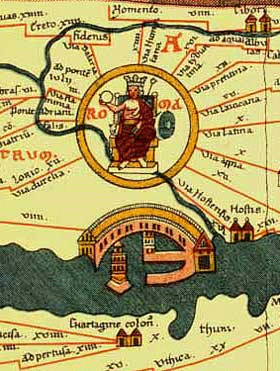
Ostia is from the word mouth - os - and like a mouth could admit nourishment or poison, trade or foreign attack.  Portus, like os, has a duality - being either an opportunity or a vulnerability - e.g., fortune (one of many cognates) may be good or bad.  Ostia was the first Roman colony, established in the early Roman republic to control emigration and trade, to tax shipping and commerce.  Siting the port colony at the mouth of the fluvial port 20 miles from Rome removed the threat of foreigners from the city of Rome, while canals and roads carried goods to and from the city.  Self-administration as a republican colony encouraged emigration of skilled artisans, craftsmen and bankers, who made rules favouring their own prosperity and collectively ensured defense.  The via Hastiensis leads to Rome from the port of Hostis in the Tabula Peutingeriana.


The port model was repeated througout the empire as an efficient way to collect tribute and taxation.  Rome asked client kings to grant fluvial or island ports (e.g., Stockholm (literally 'collective defence'), Oslo, Ostend, Hastingas, Londinium, etc.) removed from the native tribal capital but near enough for efficient trade.  Each port was governed as a republican civitas of its burgesses, which might include skilled emigrants, under a common set of Roman legal principles.  Foreign businessmen, merchants and seamen could enjoy protection from the threat of inland tribes for the purpose of trade under a common set of laws from Constantinople to Dublin - having liberty of the port.  Jewish bankers could trade coin and write bills of exchange.  They could not pass out from the port inland without the leave of the inland lord - a pass port.

The harbours and warehouses at Ostia and Portus would be similarly designed for optimising the throughput of cargos from port to warehouse to market to city.  Given the reliance of Rome on imports of food and revenues from trade in all its forms, these ports, warehouses and markets were critical civil infrastructure.

I'm currently doing the MOOC on the Archaeology of Portus with the teams in charge of excavations at the ancient Roman port.  I'm hoping to understand the methods of archaeology and the interpretation of findings to better hone my ambitions for exploration of the Roman port in the Brede Valley.  I'm already recognising that much of what existed around ancient Rome also existed in Britain under the Romans and is still reflected in some civic institutions we cherish today.

I hope to blog some of what I learn and some of what I suspect as theory to create a record for further research when I have more leisure.  Consider this the first installment.

Today I started tracing the legal entities privileged with building, operating and taxing the ports.  The development of complex commercial legal principles for the promotion of Roman trade would influence the history of global capitalism in ways that continue to be controversial.

One of the important innovations was the corporation.  Roman law in the first century evolved to recognise some collegia (colleges or guilds) and societates publicanorum (public associations) as corpora (corporations).  The legal distinction was that corporations could contract with the state of Rome for supply of food, could survive the death or resignation of partners, and the shares could be traded and inherited as investments.  Our modern concepts of joint stock corporations and equity share ownership come directly from this legal innovation.

Because the corporation was such a powerful legal construct, the scope of the privilege was severely limited by the Roman senate.   Only collegia comprising the skippers of ships (not necessarily their owners), the bakers, those running mines, and perhaps undertakers were extended the privilege of corporate status.  These were all bodies that would need to contract long term with the state to justify high investment and the maintenance of high standards of quality control and/or hygiene.

The innovation of corportions for trade along sea routes was particularly important.  Ships are extremely expensive items with a high capital cost, and the threat of storms and pirates meant that they were at constant risk of loss.  Mutualising investment to raise capital and mutualising risk to share losses would greatly encourage trade by sea.  Systems to finance the capital costs of ships, ensure equitable allocation of trade routes and cargoes, mandate collective defense and mutual assistance were the key to widespread Roman trade.  Societates naviculariorum arose naturally in many small trading villages, and some evolved into collegia naviculariorum along trade routes.  Then after the 1st century some were recognised as corpora naviculariorum under contract to the state of Rome at the principal food trading ports under Roman dominion - including Ostia, Arles and Alexandria.

I am beginning to think that rights and privileges of collegia naviculariorum as practiced at the time of Julius Caesar's dominion in Gaul were the basis for the special privileges in favour of heritability of shares and against foreign military service and taxation of inheritance which distinguished the coastal Gauls around Normandy and the ports of London, Hastingas and York in Britain.  They may even have been the pattern for ports outside the Roman Empire as in Stockholm - a name which literally translates to 'mutual defence' and originally an island remote from the tribal capital.

The recognition of York, London and Hastingas as corporate ports under republican administration of their Roman veteran colonists and shipmen - and later the Roman Catholic Church - may have evolved from the earlier privileges accorded to merchant shipmen.  Hastingas may be special because it was administered from Gaul and then Normandy.  It may have been the colony of Roman veterans that Bede describes in the 5th century as the tribe of Latins.  A similar system of mutual defence and obligation in exchange for freedom from taxation would become the basis of the Cinque Ports Federation that Godwin and Harold forced on King Edward after they successfully rebelled against the king with the aid of shipmen and landed freemen in 1052.  William the Conqueror's 1066 charter for London assuring the burgesses - both French and English - that they would remain law-worthy (enjoying republican self-rule) and that their sons would inherit echoes the corporate privileges of ancient Roman port colonies.  For a time only men who owned ships in London were privileged to vote in its councils.  The same was true in other European ports, demonstrating the persistence of the collegia naviculariorum privilege in medieval corporate ports.

There is a tantalising line that is becoming traceable from 55 BC to 1066, and that line is a little clearer to me this week.


Friday, 21 November 2014

Laudes Regiae - first performed in England in 1066

One of the reasons I re-transcribed and re-translated the Carmen was the conviction that there was much more information in the text than had been previously understood.  Even so, it can still surprise me with new insights after two years.

This morning I chased down a stray clue and found myself listening in rapture to the Laudes Regiae - the praise of kings - which was first sung in England to accompany William the Conqueror as he walked in procession to St Peter's Church in Westminster for his consecration as king of England on Christmas Day in 1066.  Just wonderful!

Laudes Regiae - praise for the king

The lines from the Carmen leave no doubt that as a conquering king William wanted his Christian authority to rule by right of conquest in battle as well as holy writ from Rome proclaimed by all.  I've had to add a new footnote as appears below:


805.         Taliter aecclesiam laudes modulando requirit
In this manner, to the singing of the Laudes Regiae,[133] the king sought the church
806.         Rex et regalem ducitur ad cathedram
And was conducted to the royal throne.
807.         Laudibus expletis turba reticente canora
The melodious Laudes complete, the crowd kept quiet.


[133] The Laudes Regiae, also known as Christus vincit, praises victory and honor and derived from the tradition of chanting to Roman generals, consuls or emperors who entered Rome in triumph after great battle.  Charlemagne adapted the tradition for his reign, using Christus vincit, Christus regnat, Christus imperat for his personal motto.  The Laudes Regiae had become a traditional accompaniment to Frankish royal consecrations by 1066.  The oldest surviving manuscript of the Laudes Regiae in England was written for Queen Matilda’s consecration in 1068. 

Wednesday, 12 November 2014

To Battle and Beyond! Finding Pevenesel and Hastinga ceastra

I gave a presentation to the Battle and District Historical Society on 16th October titled "Rethinking the Geography of the Norman Conquest".  In it I developed the theory that the Brede Valley had evolved over centuries from the site of Caesar's landings in 55 and 54 BC, to the prosperous Roman colony in Britain described by Tacitus and Bede, to the place where Aelle and the Saxons levelled the great Roman fortress of Andredcaster and slaughtered all its inhabitants in 477 AD, to the Anglo-French possession styled Portus Hastingas et Peuenisel endowed by King Offa to the Abbey of Saint-Denis in 790 AD and later by King Aethelred II to the Norman Fecamp Abbey in 1015 AD, confirmed by King Cnut in 1017 AD and again between 1028 and 1032 AD.

Wealthy Pevenesel was sacked and looted by the exiled Godwin in 1051 and 1052 AD, and after his restoration to power all the Anglo-French were killed, enslaved or exiled.  Earl Harold refused to return the port to Fecamp Abbey when petitioned by Abbot John in 1054 AD after Godwin's death, despite the support of King Edward.

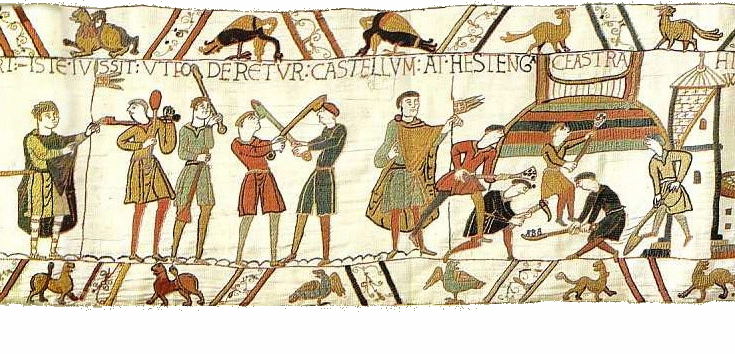
Naturally I also suggested that great and ancient estuarine port a mere 30 miles from Normandy was the secure sandy harbour where the Normans landed their fleet in 1066 and built their encampments and fortifications while waiting the approach of King Harold and the English.  The landing place was styled Hastenge ceastra in scene 45 of the Bayeux Tapestry and Hastinge portus castris at line 597 of the Carmen, earlier described at line 575 as the castra marina.


Not only did the talk go well, but it seems to have caused something of a local stir.  I am getting emails from householders and dog walkers all looking at the Brede Valley with new eyes to discover its secrets.

The following day I went myself to Icklesham to walk the footpaths and trace the geography to the lines of the Carmen.  It fits perfectly to several of the geographic references.  I stood on Hog Hill near the summit and imagined Harold's remains being laid there under a cairn of stones, just over 948 years ago, as described in lines 591-92.  

By order of the duke, here King Harold lies at peace,
That he may keep watch over sea and strand.
The pieces of the puzzle continue to fall into place, and perhaps soon there will be a better organised effort to gather the evidence and tell the story of 1066.


Monday, 28 July 2014

Persistence of Error

Most of the papers I have heard in the past four days of this conference on Anglo-Norman studies have been very good or excellent, but the pool of talent and perception is not as deep as many might think.  I have also encountered a good deal of ignorance and romanticism.  In global capital markets the difference between good judgment and bad judgment, better information and worse information, is very quickly expressed in millions of dollars of profit and loss.  Peers are highly motivated to correct misperception by relieving the incompetent of risk capital and  imposing on the credulous with loss-making 'investments'.  Those who underperform are weeded out as their losses mount.  The mechanisms and motivations for correction of error are much weaker in academic circles.  Erroneous understandings, assumptions or theories can therefore persist and become entrenched quite easily because it is easier to agree politely or say nothing at all rather than to correct and risk offence.

I have been told today that the William the Conqueror who went to war with a papal mandate was consecrated by the uncanonical and excommunicate Stigand; that King Edward the Confessor half-Norman by birth and raised for 28 years in Normandy was thoroughly English and beloved as English in his own lifetime; that popes weren't really relevant to medieval royal succession and consecration; and that Saint-Denis - the most mercantile Benedictine order in early medieval Europe - really wasn't that interested in trade or markets.  And I have been told these marvellous things by people who claim, and are even acknowledged by their peers, to be experts in their fields of study or education.  They would not have had long careers in financial markets but they can have long, placid and damaging careers in education.

I suppose that it is because England separated itself from France that some English academics can think Gallic and Frankish dominion impossible or of minor consequence in early England.  I suppose it is because England separated its church from the Roman Catholic Church that some English academics can think popes irrelevant to medieval ecclesiastical authority, royal succession and royal marriage.  I suppose it is because England evolved the Anglo-Saxon model of mercantilism that some English academics cannot imagine that the  literate and numerate clerics of medieval times may have been educated for the purpose of regulating and taxing trade and commerce.  And these less rigorous academics would much rather persist in error, and reinforce each other in error, than suffer correction of their romantic misapprehensions.  What these misguided academics have taught me is that it is rude to introduce facts or even original sources contrary to their received opinion.

If I'm wrong, I want to know it, and I want to know it now.  I don't want to persist in error and disseminate error to others for decades.

The other night I was told that religious orders really didn't bother much about the pope once they were established and vice versa.  That doesn't make sense, I suggested, as the pope expected financial contribution from religious orders, and the clerical accountants tracked whether contributions were paid.  I was told there was no evidence for my belief that popes cared about money or expected financial contributions from religious orders.  Of course there is plenty of evidence but it is ignored.  It took me only minutes once I was online again to find the commendatory letter from Pope Gregory to the Bishop of Arles recounted by Bede which reminds the bishop that his predecessor had not made payment as expected to Rome and he should remit the past due gold with the preceptor bearing the letter.  Bringing forth the evidence would do no good; my interlocutor is an authority and cannot possibly be wrong.  I must therefore misunderstand Gregory or perhaps Pope Gregory's demand for past due gold is not representative of the mercenary nature of the medieval church.

And so the learned elites will continue to give misguided papers to each other and congratulate each other on perceptions that are fundamentally flawed.  And I will continue to write rational, fact-based, well-evidenced history outside the academic mainstream.

Wednesday, 23 July 2014

1066 as a Catholic Crusade: Ports, Sees and Crowns


One of the patterns I found while researching the Carmen was the "First Christian King" pattern.  Maybe historians have already written hundreds of papers on this, but I stumbled on it as an observation, so that's how you get it here.  Like everything Roman there was a system for subjugation of client kings and the Roman system set the standards for first Christian kings in the Roman Catholic Church.  It turns out the church took possessions it received from first Christian kings very seriously, and these possessions became key territorial objectives of the Norman Conquest in 1066.

Only kings consecrated by the Catholic Church with the consent of the pope were deemed royal with rights of inheritance for their heirs in the early medieval era.  Kings sought papal approval and holy consecration to gain legitimacy and protection from challenge of rival tribal lords and neighbouring kings.  The first Christian king of just about anywhere you can name in Europe will have three things in common with other first Christian kings: (1) He was approached by a missionary sent by a pope to convert him to Christianity; the missionary baptised him and established Christianity in his realm.  (2) The king founded a priory for the care of his immortal soul in the Holy See, giving land and the revenues of an extraterritorial and inviolable canton port to the monks of the new religious order, usually Benedictines.  (3) The king founded a bishopric for a native church with an episcopal see; the see was granted liberties and revenues of a market borough so that the native church, bishops and priests might prosper and convert pagans to Christianity.  The Roman Empire had incredibly efficient systems for promoting and controlling trade and markets as the portorium and vectigalia were the principal means of streaming money from provinces to Rome.  The Roman Catholic Church church took these systems and leveraged them into a stream of secular revenues for the church and Holy See that in parallel promoted the concentration of wealth and power in the early Christian royal kings.  If you think of it as a Mafia-style protection racket, you won't be far wrong.

In England the first Christian king was King Lucius, converted sometime around 180.  According to legend he wrote to Pope Eleutherius asking to become a Christian, and the pope sent missionaries Fuganus and Duvianus to baptise the king and establish a Christian church in England.  King Lucius then founded a priory in the Holy See at Dover for the care of his immortal soul, endowing Christ Church inside the old Roman castle as a priory with revenues of the port.  He founded the archbishopric of England in London with a church for the episcopal see at St Peter-upon-Cornhill; its first bishop was Thean.  Lucius founded other churches for other bishoprics including the Old Minster at Winchester and St Martin's church in Canterbury - each with the lands and liberties of the borough flamens (river ports) for support of the church's good works and the spread of Christianity in the diocese.  King Lucius reigned for 77 years, including 54 years after his baptism, and was buried in London at his death.  After his death Christianity faded again, under attack by Romans and pagans alike, and the English church lapsed in the 4th century.

In 496 Pope Gregory sent Augustine, Mellitus and Justus with 40 monks to bring Christianity again to Britain.  King Aethelberht of Kent was married to Bertha, a Frankish princess and only daughter of Charibert I of Neustria.  Gregory of Tours says that Aethelberht married Bertha while he was already living in Neustria, so presumably his conversion to Christianity and alliance with Charibert were conditions of the marriage.  King Aethelberht was consecrated a Christian king; he founded the see at Canterbury with Augustine as the first archbishop of Canterbury, moving the archbishop's see and control of the English church from London to Canterbury.

Mellitus then converted King Saeberht of the East Saxons to Christianity, and like all first Christian kings, King Saeberht founded an abbey with a port for the Holy See and a bishopric with a see for a native church.  The abbey was consecrated to St Paul in the Roman port of London, known then as East Minster and believed the site of the earlier church granted by King Lucius.  The episcopal see was consecrated to St Peter on Thorn Island, known afterwards as West Minster.  Mellitus was ordained the first bishop to the new see at St Peter’s Westminster in 604.  Mellitus fled to Gaul after King Saeberht's death as his pagan sons sacked Westminster and London in 617.  Although Mellitus returned as archbishop of Canterbury, no bishop returned to London for fifty years, and when Wine was made bishop of London in 666 he took refuge within the city's strong walls at Old St Paul's abbey church, making it the episcopal see by usage rather than endowment, and confusing royal and Holy See jurisdictions.

Meanwhile King Aethelberht's daughter, Aethelburg, married King Edwin of Northumbria, and by  627 Paulinus, the monk who accompanied her north, had converted Edwin and a number of other Northumbrians.  Like all first Christian kings, King Edwin founded an order in the Holy See to pray for his immortal soul with revenues of a port at Lindesfarne and a bishopric with a see supported by borough market and liberties at York with Paulinus as the first archbishop.

King Cenwalh of Wessex converted to Christianity about 648, establishing a see for the diocese of Wessex at the site of the church founded by King Lucius in Winchester, which became the Old Minster and later Winchester Cathedral.  He founded a Benedictine religious order in the Holy See and gave them the Isle of Wight with port privileges for the care of his soul.  King Alfred the Great would later establish a priory in the Holy See at Winchester, the New Minster, confusing royal and Holy See jurisdictions in the borough. 

In the 8th century King Offa unified the kingdoms of England by conquering the East Saxons, Hastingas and Wessex and merging these three distinct regions with his native Mercia.  His powerful wife Cynethreth, possibly a Frankish kinswoman of Charlemagne, and Charlemagne's adviser Alcuin urged alignment with the pope and adoption of Frankish commercial administration and trade.  King Offa sent to the pope to seek consecration as king of the united realm, later visiting Rome himself on pilgrimage.  He confirmed a priory for Saint Denys at Rotherfield with the port of Hastingas & Pevenisel, known as Wincenesel to the Benedictines, and also granted by the same charter land on the strand at Lundenwick, the port of London.  He founded a new archbishopric at Lichfield for the benefit of his the northern kingdom.  Vikings had begun to raid England and had overwintered for the first time in England the year before, so perhaps King Offa was keen to secure alliance with the Roman pope and the Frankish emperor to better defend England against the Vikings and the Danes.

The Danes were not easily dissuaded from settlement and raiding in England and over the succeeding centuries more and more Danes settled in England.  First the Danes settled in the north and east, creating Danelaw - a region under Danish hegemony.  Then the Anglo-Danes of the north of England continued raiding in the south, demanding tribute from the English kings.   King Aethelred decided he needed big, bad allies to take on the Danes so he married Emma of Normandy in 1002, making her queen with primacy for her sons as legitimate heirs to the crown.  A few months later he ordered the killing of every Danish man, woman and child in England on St Brice's Day.  Among the dead was the sister of King Sweyn of Denmark and he started invading England the next year.  King Aethelred died in 1016, his son Edmund Ironside was defeated and died a few months later.  King Cnut the Great married the widowed Queen Emma in 1017.  King Cnut and his Danes and Anglo-Danes raided and enslaved widely in England, including taking possession of ports, lands and treasures belonging the church.  King Cnut still wanted Rome's legitimacy, however, so he gave a charter of protection to London to secure consecration as king of England in 1016 and a charter to Fescamp Abbey for Rameslege (the manors of Hastingas and Bretda with their port) to secure consecration of Emma as queen of England in 1017.  Both London and Rameslege remained Holy See jurisdictions with exterratoriality and inviolability.  The Roman Church, which controlled trade ports in Christian realms, would have insisted that trade with England be directed to the ports it controlled in England and the ports at London, the Isle of Wight and Hastingas would then become hugely prosperous during the decades of King Cnut's rule of England.  The frequency with which Godwin and his sons raid the Isle of Wight, Pevenisel and Hastingas during their rebellions against Edward the Confessor and each other are testimony to the appeal of Holy See ports as prosperous targets.

Bringing this back to the Carmen and 1066, William the Conqueror landed at Wincenesel - also known by then as Hastingaport.  After the Battle of Hastings when William had become lord of England by defeating and burying the excommunicate and unconsecrated King Harold under a heap of stones on the coast, he began to secure possession of the royal realm.  He marched to Dover and took possession of Dover and its port and castle, where he remained 30 days.  Envoys were sent to Canterbury and the archepiscopal see of the Church of England sent the first tribute, followed by all other urban boroughs in canonical and royal duty.  Then William marched to Winchester where the primates (the bishop of the see in Old Minster and the abbot of the abbey in New Minster) and Queen Edith, relic of King Edward the Confessor, all agree a deal offered by King William: they will accept him as king and swear loyalty, but they will only pay him market tolls - vectigalia - and not poll taxes - tributa.  Then William marches on London where the rebels have taken sanctuary and a Witenagemot has convened to make Edgar the Aethling a figurehead king.  King William guarantees the burgesses of London will retain their independent republican governance and generous liberties and they agree to renounce Edgar and swear oaths of loyalty to King William.  The bishop who holds the king's right hand in procession to Westminster is Archbishop Ealdred of York while his left hand is held by "another equal in rank", referring to the metropolitan Bishop William of London, just as London and York were deemed equal by Pope Gregory in the 6th century.

Wincenesel - a Holy See port.  Dover - a Holy See port.  Canterbury - the archbishopric of all the church of England.  Winchester - the see of the bishopric of Wessex and a Holy See borough.  London - the see of the bishopric of the East Saxons and a Holy See port.  London and York equal metropolitan bishoprics in canonical law.  Anyone else see a relevant pattern here?

The church wanted Dover back even before 1066.  Return of Dover castle was part of the oath Earl Harold swore to Duke William in 1064 when he was in Normandy.  In the Carmen Dover is the first objective after securing military victory.  King William put Dover in the custody of his brother Bishop Odo of Bayeux, returning the port to church administration.

Envoys were sent to Canterbury demanding tribute to King William.  As an ecclesiastical urban borough in the royal realm it owed tribute and loyalty to the new king.  A letter from Pope Alexander II to the clergy of England demanding canonical submission to William as the rightful king would have convinced the clerics even if the Norman army didn't.  Canterbury yields the first tribue, and all other ecclesiastical urban boroughs then send tribute and magistrates to swear fealty in duty to the new king.  That leaves Winchester and London as the hold outs.

Winchester had a confusion of jurisdiction, hosting both the see of the bishopric at Old Minster and the priory in the Holy See at New Minster.  Showing deference to New Minster within the Holy See, King William compromises to accept oaths of loyalty and customs tolls, forgoing royal tribute.  After the Norman Conquest the Norman kings forced the monks of New Minster to take residence elsewhere outside the city walls, clarifying the jurisdictions between royal realm and Holy See again.

London also had a confusion of jurisdictions, hosting the see of London at Old St Paul's church by usage from 666 and the Holy See port at the strand and the ancient dominion and liberties of the Holy See within the city from the foundation of Old St Paul's abbey in 604.  King Edward may have been rebuilding St Peter's church at Westminster in order to return the episcopal see to the site originally intended by King Saeberht and Pope Gregory, and thus restore the original intended clarity between royal and Holy See domains.  St Peter's church at Westminster was consecrated at Christmas 1065, a week before King Edward died and Earl Harold declared himself king.

The objectives of the Norman Conquest after the Battle of Hastings were the Holy See possessions of Dover, Winchester and London, and the seat of the English church at Canterbury.  The author of the Carmen was deeply knowledgeable about the history of the Roman Catholic Church in England, and the possessions of episcopal sees and Benedictine orders.  He uses the word coloni - tenants or settlers - only for the citizens of ecclesiastical jurisdictions, where citizenship was a matter of covenant and not a birthright.  He uses sedem for Westminster and Winchester, both sees of the first bishoprics established by the Gregorian Mission, even though in 1066 the bishop of London was resident at Old St Paul's within the walls of the city.  He references the equality of the metropolitan bishops of London and York. The overall import of the Carmen is that the Norman Conquest was a bit of a crusade to restore Christianity to England and restore the possessions of the Holy See, clarity of ecclesiastical jurisdiction, and canonical authority to the pope.  

King Harold was excommunicate and unconsecrated, crowning himself king in defiance of papal authority.  Archbishop Stigand was excommuniate and uncanonical, making himself archbishop in defiance of papal authority.  He defied canonical authority of five successive popes to hold the see of Canterbury without pallium, and was excommunicated by all of them.  He crowned - not consecrated - King Harold without papal assent.  Pope Alexander II wanted them both deposed in 1066 and Duke William of Normandy was his instrument for getting the job done.  The pope may not have armed divisions, as Stalin wryly observed, but the pope could declare 'open season' on monarchs he disapproved by papal excommunication.

King William reinstated Christianity in England under authority of the pope in Rome.  Like other first Christian kings he endowed an abbey in the Holy See with royal immunities for the care of his soul at Battle.  He established a bishopric for an episcopal see at Chichester (taking over from Selsey, long since dispossessed by Godwin of anything of value).  He confirmed the ancient liberties and immunities of London.  He restored dispossessed Holy See possessions at Rameslege, Steyning, Eastbourne and elsewhere to Fecamp Abbey, an order in the Holy See.  He installed Lanfranc, prior of St Etienne of Caen (Holy See religious order) and a confidante of Pope Alexander II, as archbishop of Canterbury to oversee reformation of the English church, restoring it to canonical alignment with Rome under papal authority.  He invited all religious orders and churches in England to seek restoration of dispossessed lands and liberties as they had been held under Edward the Confessor, creating a free-for-all ecclesiastical forgery industry that historians are still unravelling today.

Last year the Vatican announced that it would be digitising and publishing all the ancient records in the Vatican Library, starting with the very oldest and most fragile manuscripts.  If they kept records of Holy See possessions and episcopal sees granted by royal charters of the first Christian kings, we may yet have more proof that these possessions and sees were not just points in the landscape in 1066 but also a casus belli of the Norman Conquest.